
Alumni Interview: Learn to validate in time
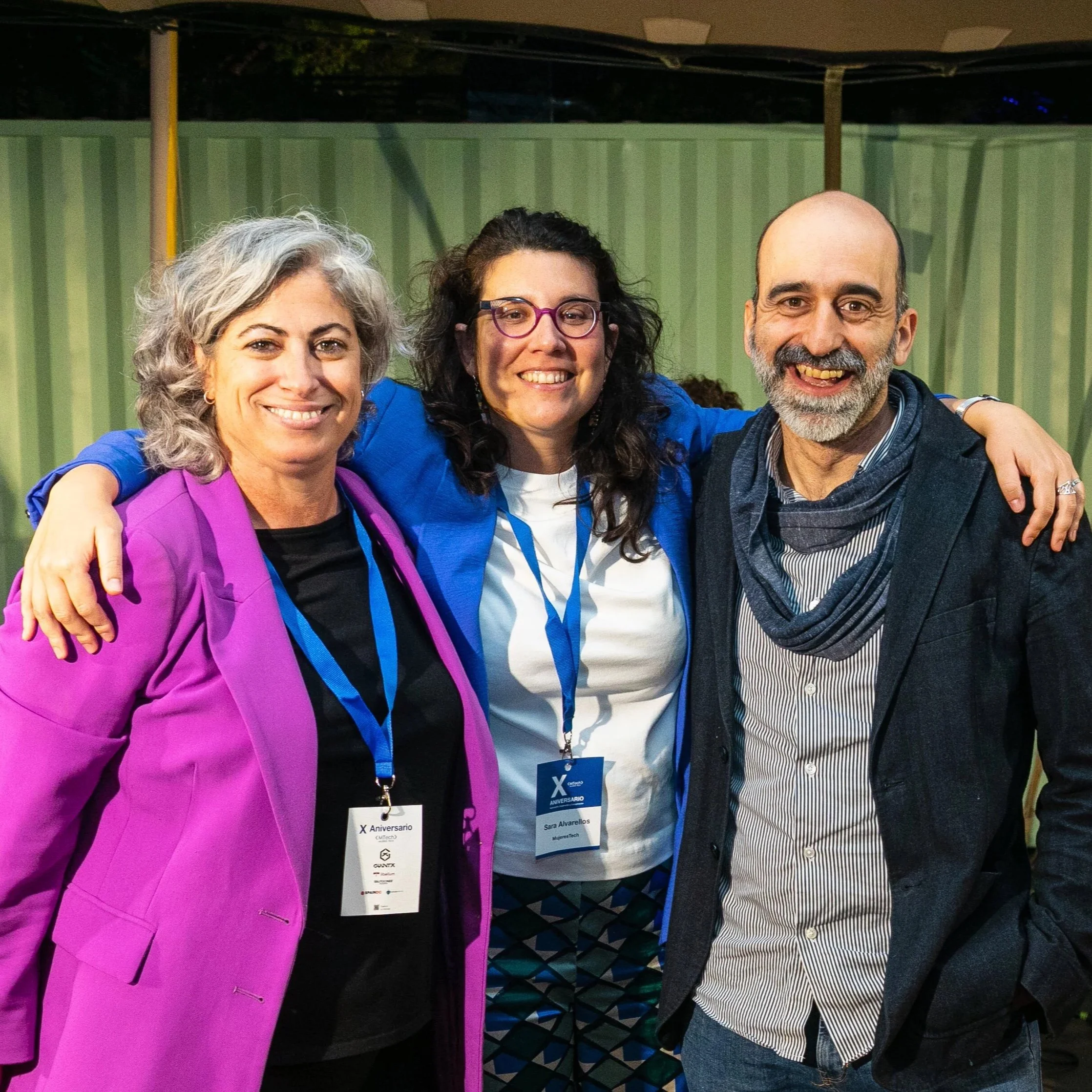
Pablo Rodríguez Monedero with Cristina Aranda and Sara Alvarellos from MujeresTech
The most valuable element of the Tetuan Valley community is the human factor. It has been more than 16 years since the first Startup School, and our family has continued to grow.
Today, we have more than 1,000 people in the community. They are all professionals, willing to help each other and share their knowledge. The Tetuan Valley community has a large number of brilliant minds who are passionate about what they do and full of ideas. Being surrounded by people who are so motivated by their projects and entrepreneurship allows you to be constantly infected with that positive energy.
In this blog, we share with you our interview with one of our alumni from Edition II. Pablo Rodriguez Monedero continues to be an inspiration, as he shares a strong passion for entrepreneurship, but also for being an improvisational actor and a great communicator.
How did you find out about Tetuan Valley? And do you remember what motivated you to participate in the program 15 years ago?
I have always been a programmer, but I was interested in becoming an entrepreneur, in creating my own project, and I felt very lost. I started to keep up with everything that was happening in the world of entrepreneurship, business creation, and new technologies. Although at that time, no one knew the word "startup," and even the word "entrepreneurship" was quite new.
I found out about Startup School when the first class graduated. The news came out in an industry publication, and I thought, "Ah, maybe this is what I'm missing, training that gives me practical knowledge about how to set up a technology project." So I went to the website and signed up for the next class, and I was very lucky that they decided to take a chance on me and admit me. And since it seemed a little strange to go in alone, I got my partner at the time to join me as a partner, because she had a problem that our project solved.
How do you remember your first day at Startup School?
I remember that Tetuan Valley used to be in a tiny office in the Tetuan neighborhood. It was a bit difficult to find because it was in a basement.
It wasn't your typical training for entrepreneurs that you might get from the government. There was a great atmosphere and the people there were very knowledgeable, and they shared their knowledge with you in a friendly way. The tables were arranged in a U-shape with all the teams facing each other. And it was really cool to see that, even though we were all different, there was a feeling that we were similar. We all wanted to invent, learn, and help each other. The community that exists now was there from the beginning.
Being surrounded by people who were eager and highly motivated to get their projects off the ground filled you with energy too. We might have ended the day exhausted, but we were still eager to work on the project the next day.
That was my feeling, that we were all like a tribe from the second day onwards. And it was like, "here, this is my place." In the end, it was about finding your place with people who have the same energy as you, in the same place.
If you had to describe your experience at Tetuan Valley Startup School in three words, what would they be?
The main word is "intense." And I think it got more intense every year.
On the other hand, it is "useful." Because every word that was said at Startup School, every thing that was done, had a reason and a purpose.
Finally, "realistic." They don't sell things that are on paper or in a book. No, at Tetuan Valley they show you the real world.
What was the most valuable thing you learned at Tetuan Valley?
My partner, although she was very interested in getting our project off the ground and was supporting me a lot, on a day-to-day basis, I was much more involved than she was, because she already had her own projects and interests. So, I think it was very good for us to ground our concepts and knowledge. We went through the training process but made very little progress in terms of MVP, which is one of the goals that Tetuan Valley has always had: to come out of the training process with an MVP.
We had lots of ideas, lots of written material, lots of things floating around, but there was no MVP. We were being pressed quite a bit, and although the presentation and product definition were very well established, the MVP was missing. The project never got off the ground; there was never an MVP to test it in the market and verify that the idea was a real need.
When I left Startup School, I kept trying to get it off the ground, but I thought of an MVP that was too big. It wasn't a real MVP, it was a powerful, developed prototype. And this caused me to lose focus because, on the one hand, I wasted a lot of time and, on the other hand, I ran out of money.
My big takeaway from this project was: make an MVP, but make it a real MVP. One that validates. Validate it however you can. Because if you don't, you might be rowing in one direction and need to pivot right away without even knowing it. So don't fall in love with it too much, and validate it.
How has your career evolved since you participated in Startup School?
I left the project, continued as a freelancer, but remained involved in the world of entrepreneurship and technology.
And that's where we begin Chapter 2, when I set up a community of developers called Betabeers, together with a friend.
To put things in context, in Tetuan Valley I met Miquel Camps Orteza , who had just entered the 3rd Edition of Startup School and was also looking for entrepreneurs with a technical profile.
At that time, all entrepreneurial events were more focused on business management or marketing. At one of the meetings we had, Miquel raised his hand and said, "I'd like to meet someone with a more technical background." From that moment on, everything took its own course. He called together everyone he had met during the Startup School program, and so 20 of us gathered in a bar in Madrid, where each person talked about their project.
We enjoyed the positive atmosphere so much that we decided to repeat the meeting the following month. A month later, we were back again, sharing updates on the progress of our projects. Then we looked at each other and said, "Let's do this every month." And so, for years, we met once a month to share ideas among entrepreneurs with a technological background.
After six months, we decided to change venues and leave the bar, but the dynamic remained the same. First, there was a very technical talk, where someone shared something about a technology they had been "struggling" with. Then, there was a project pitch session in case anyone wanted to join the project, give feedback, or simply help out. Finally, we networked over beers.
Since 2011, Betabeers has been a monthly gathering of web, app, and hardware developers. The idea was to share knowledge, give each other feedback, showcase our projects, and get to know each other.
At one of the events, some guys from Valencia came and asked us to open a franchise there. And that's when our expansion began, reaching 27 cities in Spain and another four abroad.
However, it gradually slowed down in many cities. I had other projects on the go and couldn't devote as much time to it. Just when we were about to bring in a new generation in Madrid, the pandemic hit... With everything that was going on, we didn't switch to an online format, and that was that.
Now, after five years, I want to bring that community back and organize Betabeers in Madrid. I think it's always good for entrepreneurs to have that space to pitch, get more feedback, and meet people in the industry. So stay tuned, because Betabeers may be back this year.
Returning to my career path, when my business venture didn't take off, I spent some time freelancing and have been jumping between working for others and working as a freelancer.
I have tried to launch a few entrepreneurial projects in the role of CTO, but we couldn't quite get the partners to fit together, and we soon decided that it wasn't going to work. It's true that I always feel the urge to start my own business and launch my own project. That's why I want Betabeers to come back to life, because it's a project that I managed to make work and that can still work.
What is your relationship with Tetuan Valley today?
I helped organize Startup School on two occasions. And, since I have been an improvisational theater actor for almost 20 years, I have given a few sessions to Tetuan Valley students on how to speak in public and make a good pitch.
What advice would you give to new students?
I encourage people who have a project in mind to submit it to Startup School. Even if you don't get into the Tetuan Valley program, the experience of preparing the presentation and presenting it is very interesting. In addition, you receive valuable feedback during the pre-selection process.
And my advice to people who manage to get in and want to carry out the project is to make the most of it. They have to take advantage of learning, what they have to change, and know how to evolve quickly.
It is also very important to learn to listen and receive feedback. Don't get defensive. Tetuan Valley may give you a reality check, but it will be to lift you up. It will make you stronger and help you get rid of all the things that don't work. All feedback works in your favor. So don't waste time defending yourself against feedback. Just take note.
If you are interested in reading more stories like this, in this article you can find out what it was like to take part in the first edition of the program.
Traditional SEO is dead, and we believe that's the best thing that could have happened to us. In this article, written in collaboration with Angelica Pimentel (founder of POiN and Tetuan Valley alumna), we analyze how search in 2026 has gone from "keywords" to "human conversations." Discover why stopping talking 'Googles' and regaining your natural voice is now your biggest competitive advantage over AI.